GETTING AHEAD
If you've spent part of your life, or most of your life, struggling to get by in the world, the idea of actually getting ahead might seem out of reach. But even if your story has been filled with barriers, vanishing opportunities, and setbacks, the next chapter can change all that. Yes, you have to write it, but you don't have to do it alone. Getting ahead in a just-gettin'-by world takes you step by step through a discovery of yourself like no other. It's not just about how you got to where you are now. It's also about what comes next to build the life you want. |
|
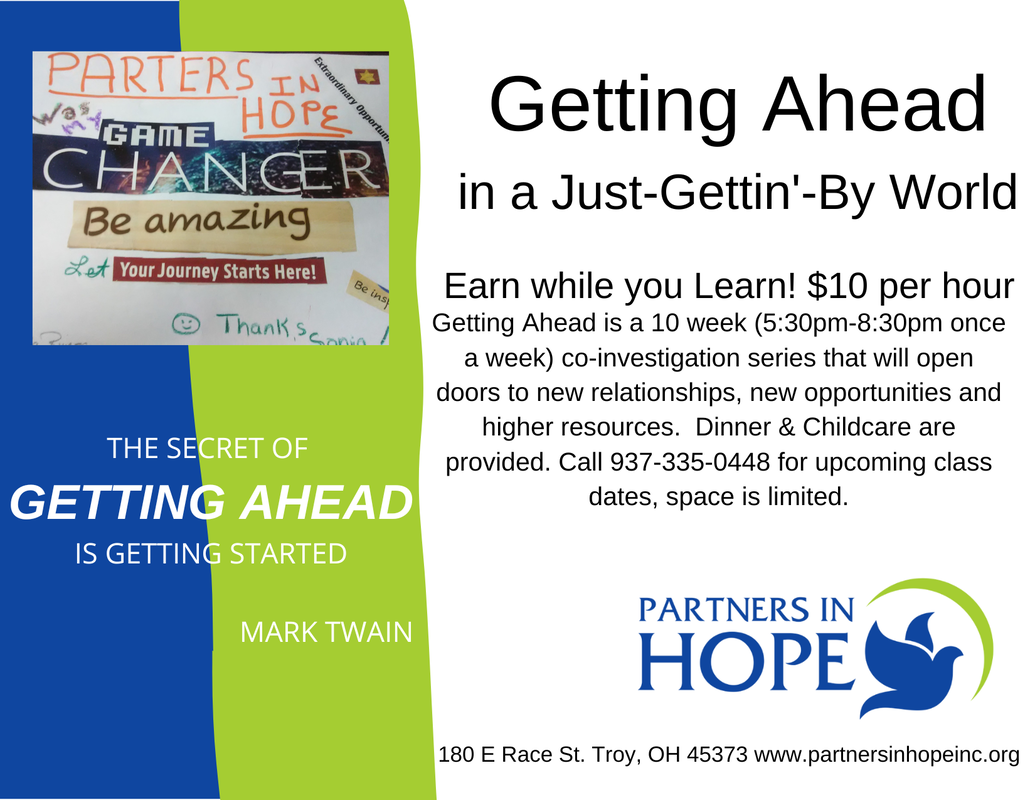
Getting Ahead is both a workbook and an experience. It’s based on Philip DeVol’s Getting Ahead in a Just-Gettin’-by-World: Building Your Resources for a Better Life. Participants, called Investigators, work in groups to examine the impact of poverty on themselves and their communities and explore the world through the lens of economic class.
|
Partners in Hope provides Getting Ahead, a small group experience for low income families.
|
Click HERE for a video of a Getting Ahead Graduation in Dayton!
FINANCIAL $ENSE
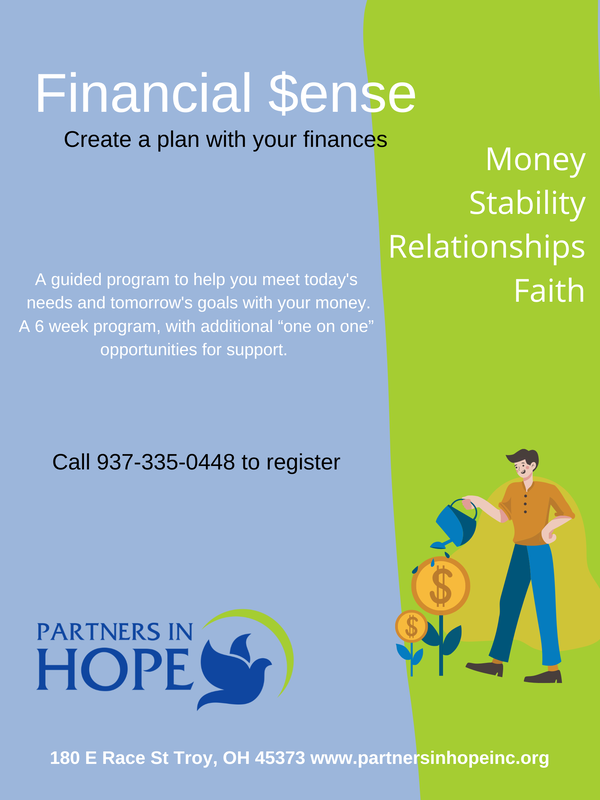
A faith based money management program that supports families as they create a plan for their finances. The program is run as a 6 week program, with additional “one on one” opportunities for support. Designed specifically for low-income adults, Financial $ense addresses the challenges the financially limited family. It provides a knowledgeable, confidential, reality based process for families to develop and work their individual spending plan, resulting in increased economic stability. |
|
- Classes run one time per week for (1.5) hours for 6 consecutive weeks.
PARENTING CLASSES
NEW CLASSES for parents to meet the needs of the community!
Do you have a hard to raise child? Do you have a child with ADD/ADHD? Parents are not given a manual at the hospital when a child is born. Join us to:
▶ Learn how to never argue with your child again
▶ Prevent or intervene in alcohol or drug use
▶ Improve school attendance and performance
▶ Explore concrete solutions for media issues
We offer a few different parenting classes to fit the ages of your child(ren).
THE R RULES
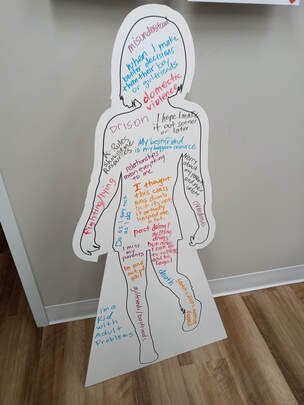
The R Rules curriculum is designed for middle and high school students to identify, develop, and build resources. It is an asset-based model built on the foundation that all people have resources, all people are problem solvers, and all people use the resources available to them to meet day to day challenges and live well. Resources are defined as anything available to an individual, institution, or community that helps or supports. The R Rules is designed to increase awareness and acknowledge students’ unique talents and inspire hope.
A foundation to the model of R Rules is the use of personal planners that are structured, standardized notebooks that can be personalized with text, illustrations, and photos to support the student’s day to day activities. Students will also develop R Rules Professional Portfolios in paper and electronic formats, used to support applications and interviews with schools, employers, and other programs. They will also develop and engage in community activities and service projects, attend community meetings, contribute, build resources, and develop voices as citizens and leaders.
GETTING AHEAD WHILE GETTING OUT
The purpose of the Getting Ahead while Getting Out Reentry Model is to provide citizens returning from incarceration and their families a comprehensive, community and relationship based approach to reentry that begins in pre-release and follows through with long-term support.
The goal is to engage incarcerated individuals, their families, volunteers, community organizations, and people in corrections as problem solvers who work shoulder to shoulder to create communities where everyone can live well.
The goal is to engage incarcerated individuals, their families, volunteers, community organizations, and people in corrections as problem solvers who work shoulder to shoulder to create communities where everyone can live well.
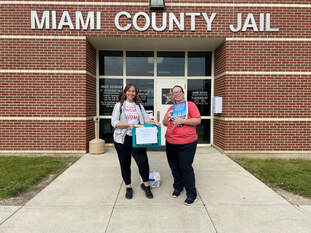
The program can help under-resourced individuals returning from incarceration to:
- Stabilize and take charge of their lives
- Complete a self-assessment of their own resources and make plans to build them
- Develop a series of mental models to examine their own lives and create new future stories
- Investigate the impact that poverty has had on themselves and their community
- Use this information to build resources for a better life and community
The GAWGO program provides:
- Participants earn $10 an hour which can be put towards fees and fines, Christmas Shop, commissary, savings for release.
- Participants set goals in which we can assist in reaching them and barrier removal through case management such as housing, transportation, mental health services, SSI/SSD claims and or employment.
- Upon release participants may come to Partners In Hope and receive Relief services such as birth certificates, id’s, PPE for Employment, toiletries and clothing vouchers.
- Mentorship opportunities available
COMMUNITY TRAINING
Bridges out of Poverty
This training provides an introduction to the “hidden rules of class”, language and communication, the framework for understanding poverty and how community organizations can help to bridge the gap with low-income individuals. Learn the basic framework for understanding the culture of poverty and enable your organization and individuals to become more effective in addressing poverty issues in the community.
Partners in Hope staff members are available to conduct Bridges Out of Poverty trainings for current and prospective volunteers and our partnering churches.The training is based on the book Bridges Out of Poverty, co-authored by Dr. Ruby Payne, Philip DeVol and Terie Dreussi Smith. The training also highlights the various resources required to move out of poverty. The content of the class is similar to the content of Getting Ahead, but it is geared toward middle and upper income class audience.
The content covered in both Getting Ahead and Bridges Out of Poverty provides those who participate with a common language, helping to facilitate successful relationships across economic lines.
Partners in Hope, Inc. staff and volunteers are authorized by AHA!Process to provide full day and two day trainings throughout Miami, Shelby, Darke, and Auglaize Counties.
Partners in Hope staff members are available to conduct Bridges Out of Poverty trainings for current and prospective volunteers and our partnering churches.The training is based on the book Bridges Out of Poverty, co-authored by Dr. Ruby Payne, Philip DeVol and Terie Dreussi Smith. The training also highlights the various resources required to move out of poverty. The content of the class is similar to the content of Getting Ahead, but it is geared toward middle and upper income class audience.
The content covered in both Getting Ahead and Bridges Out of Poverty provides those who participate with a common language, helping to facilitate successful relationships across economic lines.
Partners in Hope, Inc. staff and volunteers are authorized by AHA!Process to provide full day and two day trainings throughout Miami, Shelby, Darke, and Auglaize Counties.
PIH Poverty Simulation
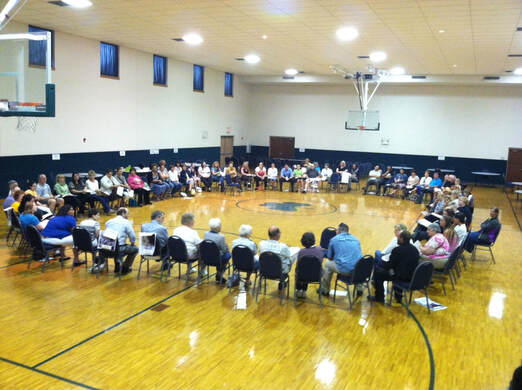
What is it? This simulation seeks to help middle and upper income individuals understand the realities of living in poverty. During the simulation, participants role-play the lives of low-income families, from single parents trying to care for their children to senior citizens trying to maintain their self-sufficiency on Social Security. Each simulation takes place in a virtual town with the resources that are typically available to low income families. The task of each family is to go through the daily activities of life, i.e. paying bills, providing food and shelter, providing childcare, etc. while interacting with various community resources.
How many people can participate? 30-130, depending on the space available
What are the requirements to host a poverty simulation?
How many people can participate? 30-130, depending on the space available
What are the requirements to host a poverty simulation?
- A large space
- Be able to supply at least 12 tables and at least 100 chairs
- Be willing to help recruit volunteers to help staff the event.
- Ability to cover expenses of the event
|
|
|

|

|
Copyright © 2016